
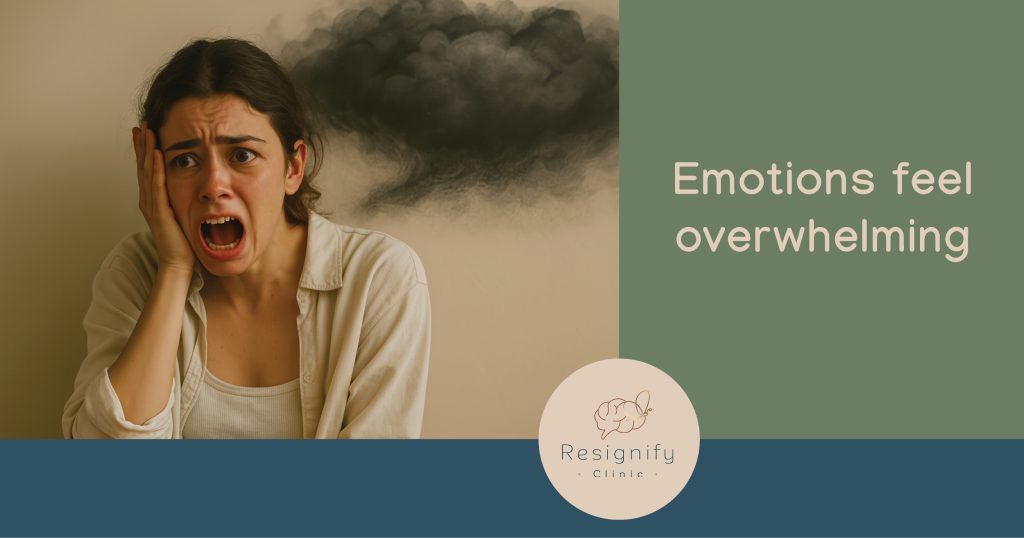
Emotions are powerful and at times, they can feel all-consuming. If you’ve ever wondered why your emotions feel too intense or hard to control, you’re not alone. Many people struggle with emotional regulation, often without understanding the underlying reasons. Let’s explore the common challenges that make emotions feel overwhelming – and how to begin addressing them.
1. Biological factors
Some people are biologically more sensitive to emotional triggers. This means you may react more quickly, feel emotions more deeply, and take longer to return to a calm state. This heightened sensitivity is not a flaw – it’s often simply how your nervous system is wired. However, it can make navigating emotional experiences more exhausting, especially in high-stress environments.
2. Lack of emotional regulation skills
Emotional regulation is not something most of us are taught growing up. Without tools like deep breathing, grounding techniques, or healthy self-expression, emotions can build up until they feel unmanageable. When we don’t know how to respond to emotional discomfort, we may suppress it or let it erupt – both of which can lead to longer-term difficulties.
3. Reinforcement of emotional behaviours
Sometimes, emotional intensity is inadvertently rewarded. For instance, if support or attention is only given when someone is visibly upset or in distress, they may learn that strong emotional displays are the only way to have their needs met. Over time, this can create patterns that are difficult to break and leave individuals stuck in cycles of emotional reactivity.
4. Mood-driven decision-making
When emotions are intense, it becomes harder to access logic or reason. We may allow our current mood to guide our decisions, even when those choices are not in our best interest. Acting from a place of distress can lead to regret or reinforce the belief that emotions are dangerous or uncontrollable.
5. Emotional overload
There are moments when the sheer intensity of our emotional experience overwhelms our ability to cope. This is called a skills breakdown point – when emotions override our capacity to think clearly, recall calming strategies, or reach out for support. In these moments, people often shut down, lash out, or feel paralysed.
6. Emotional myths and internalised beliefs
Many of us grow up with unhelpful or harmful beliefs about emotions. We might have been told that crying is a sign of weakness, or that we should “just get over it.” Others believe that intense emotional expression is the only way to be authentic. These myths make it harder to view emotions as manageable and can contribute to shame or fear around feeling deeply.
Learning to regulate emotions is possible
The good news is that emotional regulation is not a fixed trait – it’s a skill that can be developed, like learning a language or an instrument. With the right tools, support and practice, you can build greater resilience and respond to your emotions in ways that feel empowering rather than overwhelming.
At Resignify Clinic, we understand how frustrating it can feel to be trapped in emotional cycles. Whether you’re struggling with anxiety, burnout, or emotional sensitivity, support is available. Maya offers a safe and non-judgmental space to explore your emotional patterns and learn practical techniques to better manage them.
You don’t have to navigate emotional intensity alone.
Book a session with Maya today and take the first step toward emotional clarity and balance.